
Lafourche Parish Court Records After a Jail Arrest
An arrest in Lafourche Parish usually starts with transport to the Lafourche Parish Correctional Complex, where the person is booked into the jail-management system. That booking can appear on the LPSO roster with a name, race, sex, date of birth, cell block, arrest date, and hold reasons. The court record starts in a different place. Formal criminal prosecution is handled by the Lafourche Parish District Attorney, and the DA homepage identifies Kristine Russell as the District Attorney. Her office, or a designated assistant district attorney, has charge of state criminal prosecutions in the district, represents the state before the grand jury, and advises the grand jury.
That distinction matters because jail charges and court charges are not always identical. The roster may show the arresting charge, bond, a court division note, a probation or parole detainer, or an additional hold. The Clerk of Court and 17th Judicial District Court records show the filed case, docket activity, court events, and formal charge status after DA review. Use jail inmate records for the custody side and jail mugshots for booking-photo limits. Use the Clerk and court systems for the prosecution record that follows an arrest.
How to Find Lafourche Parish Court Records After an Arrest
The most practical sequence is roster first, court second. Start with the LPSO roster if the arrest is recent, because the jail record may identify the booking date, listed charges, bond text, division setting, and whether another agency is holding the person. Then move to the Lafourche Clerk of Court record systems for the formal court file. The Clerk records-search page says online civil and criminal records are available by subscription, with indexes from July 1, 1982 to present, minute entries from January 1, 2001 to present, and images from March 2018 to present. Older images may be available after redaction.
- Open the LPSO roster and identify the person by name, DOB, race, sex, cell block, and arrest date.
- Read the hold-reasons text for listed charges, bond, no-bond language, detainers, court division notes, or sentence language.
- Use the Lafourche Clerk civil and criminal records search for the formal docket once a case is filed.
- Check the Clerk Connect Court Event Inquiry for upcoming civil or criminal court dates when the case has a scheduled event.
- For certified copies, unreleased images, older records, or official public records, contact or visit the Clerk rather than relying only on a web index.
The Clerk's records-search page lists paid online access options: 30 Day Unlimited Access at $50 monthly, 1 Day Unlimited Access to Index and Images at $20 daily, and 1 Year Unlimited Access at $550 annually. The Clerk states that separate subscriptions or fees are required for each system and that the official public records are those provided in the Clerk's office. The criminal department page lists a $20 criminal background search fee, photocopies at $1 per page, and certified copies at $5 per docket number.
The Lafourche Clerk records-search page documents the online civil and criminal record subscription terms. See the Clerk records-search page for the source system and fee notice.
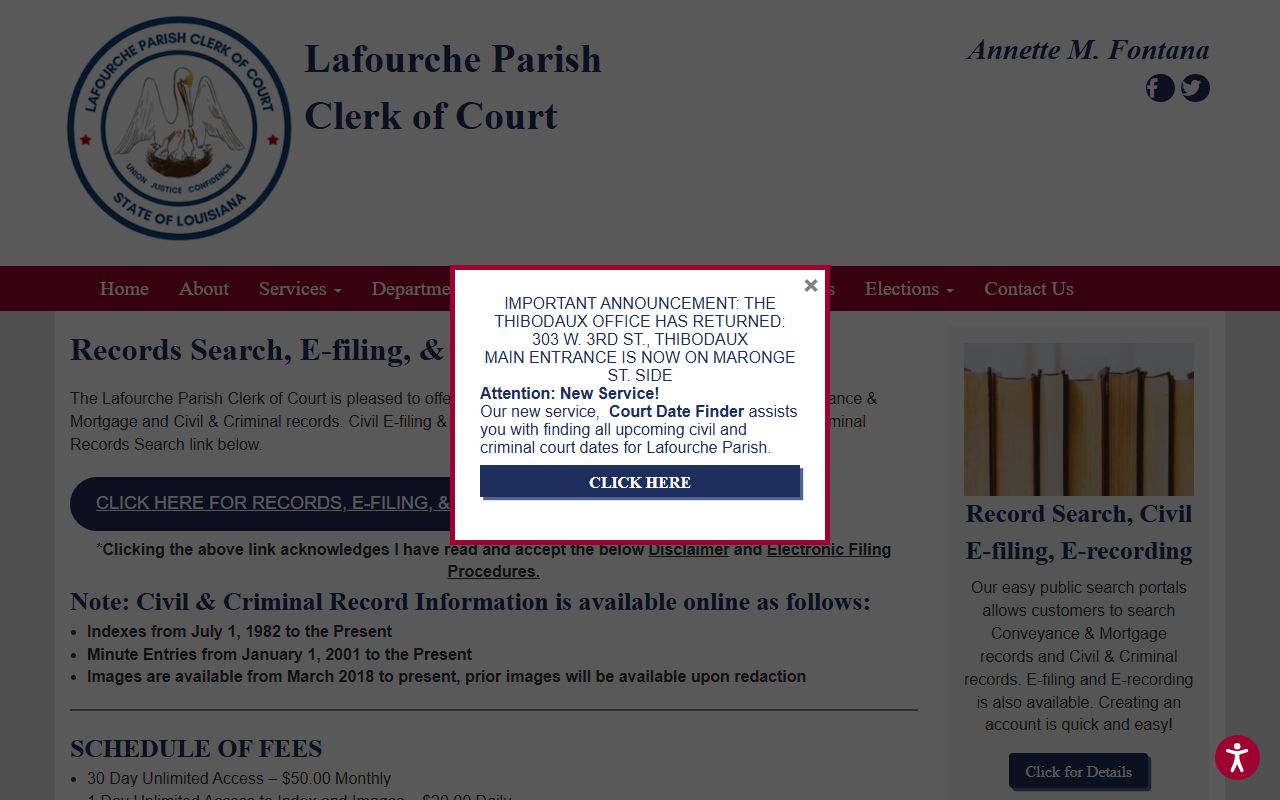
The screenshot is useful because it shows the court-record access point is not the jail roster. It is the Clerk's record system, with its own date ranges, account access, and official-record disclaimer.
Court Search Fields and Related Lookup Tools
The research did not expose every Clerk Connect query field without portal interaction, but it did identify the systems and the type of access each supports. Treat the jail roster, the Clerk records search, and the court event inquiry as separate tools. A roster match helps identify the arrest and charge language. The court event inquiry helps locate scheduled court activity. The Clerk records system is the route for the civil and criminal docket and images when online access is available.
| Portal | Field or Access Type | Required | Notes |
|---|---|---|---|
| Lafourche Clerk records search | Account or subscription | Yes for full online use | Public page gives fees and date ranges; complete query fields were not visible without portal access. |
| Clerk Connect Court Event Inquiry | JavaScript court-date portal | Unspecified | Clerk site presents a Court Date Finder for upcoming civil and criminal events. |
| LPSO roster | Name, race, sex, in-custody date, arrest date | No field required in the roster configuration inspected | Shows jail charges and holds, not the official prosecution filing. |
| LPSO active warrants | Name, race, sex, DOB, charge, bond amount | Search criteria required | Useful before an arrest or when an arrest results from an active warrant. |
How Charges Get Filed After an Arrest: Complaint, Information, and Indictment
After booking, the prosecution decision belongs to the District Attorney, not the jail. The DA may accept the arrest charge as filed, amend it, reduce it, add related counts, decline it, or dismiss it later. Louisiana criminal cases may involve a complaint or citation, a bill of information filed by the prosecutor, or an indictment returned by a grand jury. The court record after a jail arrest should be read from the filed charging document and docket activity, not only from the roster's first charge label.
| Complaint or Citation | Bill of Information | Indictment | |
|---|---|---|---|
| Filed By | Officer or prosecuting authority, depending on the case type | District Attorney | Grand jury |
| Common For | Traffic, summons, lower-level, or initial charging contexts | Many Louisiana felony and misdemeanor prosecutions | Serious felony matters requiring grand-jury action |
| Public-Record Note | Summons and citation records are treated as public records under Louisiana law unless another exception applies | Louisiana R.S. 44:3 identifies bills of information as public records | The indictment frames the formal prosecution, while some grand-jury material remains restricted |
| Relationship to Jail Arrest | May track the arresting accusation | May differ from the booking charge after DA review | May replace or refine earlier arrest-charge language |
Charge Status in Court Records After an Arrest
Charge status can shift after the arrest. A person can be booked on one charge, held on a detainer, then appear in court on a different or refined charge once the prosecutor files. Roster language such as "No Bond," "Set By Division E," probation or parole detainers, additional holds, and sentence-imposed text is useful for immediate custody context. It is not the final court disposition. Always read each count separately because one charge may be pending while another is dismissed, reduced, or already sentenced.
| Status | What It Means |
|---|---|
| Pending | The charge has not reached a final disposition. Court dates, motions, bond conditions, or plea negotiations may still be active. |
| Amended or Reduced | The charge was changed by the prosecutor or court. The final case may not match the initial jail booking charge. |
| Dismissed | The charge is no longer being pursued in that case, although other counts or holds may remain active. |
| Nolle Prosequi | The prosecutor declined to pursue or dismissed the charge. It is a prosecution decision, not the same as a not-guilty verdict. |
| Sentence Imposed | The court entered punishment after conviction or plea. The roster may show sentence days or concurrent language for custody tracking. |
Bond and Release After an Arrest
LPSO's bonding page says bond transactions can be completed at the Lafourche Parish Correctional Complex or at the South Lafourche Sub-Station. Before traveling or paying, confirm that the person is still in custody, that the bond amount is current, and that no separate hold prevents release. A paid bond on one count may not release a person who also has a probation hold, parole hold, DOC hold, federal hold, immigration hold, or another agency detainer.
| Bond Type | How It Works in Lafourche Parish |
|---|---|
| Cash Bond | Cash, money order, or credit card may be used for the total bond amount. LPSO notes a $30 bond fee and refund handling after proceedings, excluding fines and costs. |
| Surety Bond | A licensed bonding agency posts the bond power for a fee. LPSO states it does not recommend bonding companies or take part in that private transaction. |
| Property Bond | Land is pledged as collateral after assessment and clerk paperwork. All owners must be present with valid photo ID, and the final value must cover the bond. |
| Personal Recognizance | A judge authorizes release on a written promise to appear. The jail cannot create a PR bond without a judge's order. |
| No-Bond Hold | The person cannot be released on that listed hold unless the court or holding agency changes the status. |
Warrants That Lead to an Arrest and Court Records
LPSO publishes an official active-warrants search through the same Zuercher/CentralSquare portal family as the inmate roster. The warrant search requires criteria and can show name, race, sex, DOB, charge, and bond amount. A warrant may lead to a new booking at LPCC when the person is arrested or self-surrenders. A bench warrant can also explain why a court record shows missed-court activity before the jail roster shows a new arrest date.
Common warrant categories include arrest warrants, bench warrants, fugitive warrants, search warrants, and probation or parole warrants. Lower-court and municipal warrants may not be complete in a sheriff-facing search, so verify with the issuing court or the Clerk when a missed court date is suspected. Do not try to resolve a warrant through a private web form. Use the court, an attorney, LPSO, or the issuing agency.
The LPSO active-warrants portal shows the search route for outstanding warrants. Review the LPSO active-warrants search when warrant status may explain an arrest.
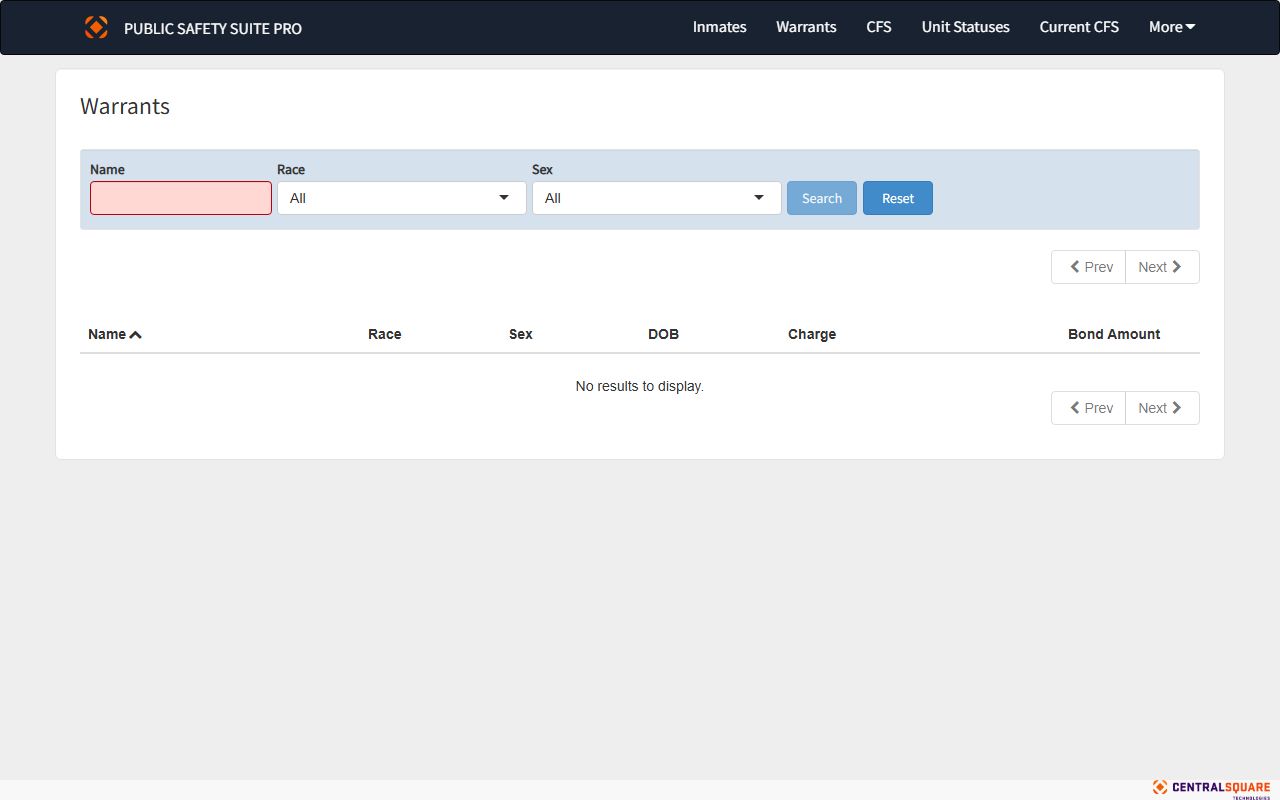
Warrant data is a lead, not a substitute for the court file. Once a warrant results in booking, the formal prosecution and court-date record must still be checked through Clerk and court channels.
Charges vs. Convictions
An arrest and charge are accusations. A conviction is a court outcome, usually after a guilty plea, verdict, or other adjudication. Lafourche Parish court records after a jail arrest should be read carefully because the same person may have a booking record, pending charges, dismissed counts, probation holds, and convictions in different parts of the record. Do not treat a jail roster charge as proof of guilt.
| Charge | Conviction | |
|---|---|---|
| Stage | Accusation after arrest, citation, bill of information, or indictment | Final court result after plea, verdict, or qualifying adjudication |
| Proof Level | Lower threshold tied to arrest or filing decisions | Resolved under criminal-court standards and procedures |
| Public Record | Often public, subject to juvenile, victim, sealed-record, pending-investigation, or statutory limits | Often public, subject to sealing, expungement, and other access limits |
| Practical Use | Shows what was alleged or filed | Shows what the court finally decided |
Sealed vs. Expunged Arrest Records
Louisiana access law makes booking records and certain criminal filings public, but not every record remains available to every requester forever. Juvenile records, victim information, pending investigative details, and sealed or expunged matters may be restricted. The Lafourche Clerk criminal page says expungement forms and fees are available, that the Clerk cannot give legal advice, and that fees are nonrefundable even if a request is denied. Louisiana Code of Criminal Procedure article 983 sets expungement-processing fees, including $250 to the Louisiana Bureau of Criminal Identification and Information, $50 sheriff fee, and $50 district attorney fee.
| Sealed | Expunged | |
|---|---|---|
| Public Visibility | Hidden from ordinary public access by court order | Removed from public access for qualifying records under Louisiana expungement procedures |
| Agency Access | Some agencies may retain limited legal access | Some criminal-justice access may remain, depending on the order and law |
| Local Route | Check the court order and Clerk record status | Use Clerk expungement forms and fee instructions, or consult counsel |
| Effect on Online Records | May restrict public display | May support a request to correct or remove public access to qualifying records |
Background Check Considerations
LPSO has a separate background-check page and records-section contact, while the Clerk has a criminal background search fee. These routes are not the same as a consumer report for employment, housing, credit, insurance, or tenant screening. Anyone making an official decision about another person must use legally compliant sources and procedures, not a casual web lookup or a public roster screenshot.
Important: This private site is not a consumer reporting agency and may not be used for any FCRA-covered purpose.
Restricted Court Records After an Arrest in Lafourche Parish
Louisiana R.S. 44:1 defines public records broadly, including writings, photographs, electronic records, and data used for public business unless an exception applies. R.S. 44:31 gives adults the right to inspect, copy, or reproduce public records, and R.S. 44:32 addresses custodian duties, reasonable copy fees, and written response obligations when a question is raised. R.S. 44:3 allows some pending law-enforcement and investigative records to be withheld, while still identifying initial reports, booking records under article 228, summons or citation records, and bills of information as public records. Article 228 says the booking book and booking information summaries are always open for public inspection.
Those access rules do not make every detail public. Juvenile information, victim-protection material, security information, sealed matters, expunged matters, and active investigative details may be redacted or withheld. For LPSO records not published online, the public-records route is a request to Chief Deputy Roy Gros, Custodian of Records, P.O. Box 5608, Thibodaux, LA 70302, or roy-gros@lpso.net. For official court copies, use the Lafourche Parish Clerk of Court rather than the jail roster.